

At first glance, a Russian Toy and a Chihuahua can look remarkably similar. Both are tiny companion dogs with alert expressions, upright ears, and plenty of personality. Look a little closer, however, and you'll notice differences in body shape, coat, history, and typical behavior.
If you're deciding between a Russian Toy and a Chihuahua, size alone shouldn't make the decision for you. Both breeds need thoughtful training, regular activity, dental care, and protection from hazards that can be particularly dangerous for very small dogs.
This guide compares their physical characteristics, temperament, grooming, exercise, health considerations, and suitability for different households so you can make a more informed choice.
Quick answer: Russian Toy vs. Chihuahua
The Russian Toy generally has a longer-legged, more elegant build, while the Chihuahua often has a more compact appearance and a distinctive rounded head shape. Both are lively companion dogs, and either can suit apartment living. The better choice depends on the individual dog's temperament, your household, and the care you can provide.
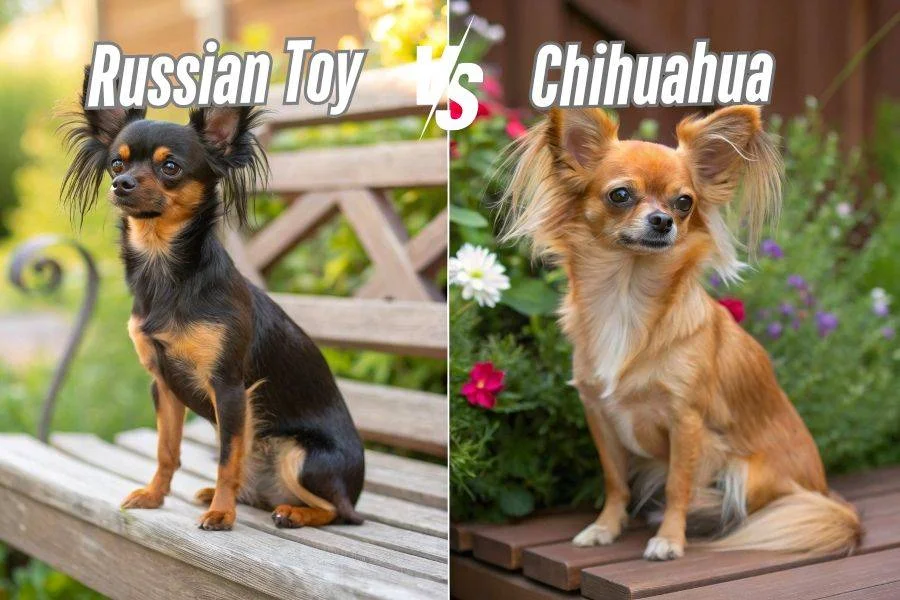
Russian Toy vs. Chihuahua: Breed Comparison
| Feature | Russian Toy | Chihuahua |
|---|---|---|
| Origin | Russia | Mexico |
| Typical height | 8–11 inches | About 5–8 inches in the AKC breed profile |
| Weight | Up to 6.5 pounds under the AKC standard | No more than 6 pounds under the AKC standard |
| Coat varieties | Smooth and longhaired | Smooth coat and long coat |
| Typical personality | Lively, affectionate, intelligent, sometimes reserved with strangers | Alert, confident, loyal, and often spirited |
| Exercise | Regular walks, play, and mental stimulation | Regular walks, play, and mental stimulation |
| Life expectancy | 12–14 years in the AKC breed profile | 14–16 years in the AKC breed profile |
| Apartment living | Can adapt well with exercise, training, and companionship | Can adapt well with exercise, training, and companionship |
These figures describe breed standards or typical breed-profile estimates, not every individual dog. Actual size, behavior, and lifespan vary.
1. History and Origin
The Russian Toy
The Russian Toy developed in Russia from small English toy terrier-type dogs. These dogs became companions among Russian aristocratic households. Over time, breeders developed the Russian Toy into the small, elegant companion breed recognized today.
The breed comes in two coat varieties: smooth and longhaired. The longhaired variety is especially recognizable for the feathering around its ears, legs, and tail.
The American Kennel Club (AKC) officially recognized the Russian Toy in 2022. Despite the breed's small size, Russian Toys are active dogs that often enjoy games, training, and close contact with their owners.
The Chihuahua
The Chihuahua is associated with Mexico, and its early history is not completely documented. Its ancestry is often discussed in connection with the Techichi, a small companion dog associated with ancient Mexican civilizations, although details of that connection remain uncertain.
Modern Chihuahuas became established in the United States during the late nineteenth century. They are now known for their tiny size, alert expression, and confident personality.
The breed has smooth-coat and long-coat varieties. Both belong to the same Chihuahua breed rather than representing two separate breeds.
Key difference: The Russian Toy's development is closely associated with Russia and small terrier-type ancestry, while the Chihuahua has a history rooted in Mexico. Both are primarily companion dogs today.
2. Physical Appearance: How Can You Tell Them Apart?
Because these breeds are similarly small, it can be difficult to tell them apart at a glance. Their proportions, head shape, coat, and movement offer more useful clues than size alone.
Russian Toy Appearance
The Russian Toy has a fine-boned, slender body with relatively long legs. Its overall appearance is elegant rather than stocky, and it often moves with a light, lively gait.
Its ears are large and upright. In the longhaired variety, the ears develop noticeable feathering that can make the breed easier to recognize.
The smooth-coated Russian Toy has short, close-lying hair. The longhaired variety has a longer coat with feathering around the ears and limbs.

Chihuahua Appearance
The Chihuahua has a compact body and a distinctive head shape. The apple-head type has a rounded skull, although individual Chihuahuas vary in appearance. Their eyes are expressive, and their ears are generally large relative to their heads.
Chihuahuas come in smooth-coat and long-coat varieties, and their coats can appear in many colors and combinations. Their small size does not prevent them from being active, alert, and confident.

Which Dog Is Smaller?
Under the AKC breed standards, the Chihuahua has a maximum standard weight of 6 pounds, while the Russian Toy can weigh up to 6.5 pounds. The Russian Toy is generally taller, with a breed-standard height of 8–11 inches.
However, individual dogs do not always fit neatly into standard measurements. If you're choosing a puppy, ask about the parents' size and health rather than relying on a seller's prediction alone.
3. Temperament and Personality
Both breeds form close bonds with their families. They can be playful, alert, and surprisingly energetic for such small dogs. However, no breed description can predict exactly how an individual dog will behave.
Russian Toy Temperament
Russian Toys are commonly described as lively, intelligent, affectionate, and eager to interact with their owners. Many enjoy learning tricks and participating in activities that give them a chance to use their minds and bodies.
Some are reserved around unfamiliar people, so early, positive socialization can help them become more comfortable in different situations.
Although their small size makes them suitable for many homes, they still need training and supervision. A Russian Toy should not be expected to behave well automatically simply because it is a companion breed.
Chihuahua Temperament
Chihuahuas are often confident, alert, and devoted to their owners. Some are outgoing with visitors, while others need more time to feel comfortable around unfamiliar people.
They can be vocal, particularly when they have not learned how to respond calmly to noises, visitors, or other dogs. Reward-based training and appropriate socialization can help prevent unwanted barking and improve everyday manners.
Chihuahuas are not necessarily stubborn or aggressive. Their behavior depends on genetics, experiences, training, and the way their owners respond to them.
Which Breed Is Friendlier?
There is no reliable rule that Russian Toys are always gentler or that Chihuahuas are always more territorial. Both breeds can be affectionate companions, and both can be cautious around unfamiliar people.
If temperament is your main concern, meet the individual dog if possible. Observe how it responds to handling, new surroundings, and unfamiliar people. Ask the breeder or rescue organization about its behavior rather than relying solely on breed stereotypes.
4. Are Russian Toys or Chihuahuas Good Family Dogs?
Either breed can live successfully in a family that understands the needs of a very small dog. The most important consideration is how carefully children and adults handle the dog.
Russian Toys and Chihuahuas can be injured by rough handling, accidental falls, or being stepped on. They may not be suitable for households where young children cannot consistently respect an animal's space.
Children should be taught to approach calmly, avoid grabbing or lifting a dog without help, and leave it alone while eating or sleeping. All interactions between dogs and young children should be supervised by a responsible adult.
For a household with older, gentle children, either breed may be a good companion. The individual dog's temperament and previous experience with children matter more than assuming one breed is automatically safer or more patient.
5. Training and Socialization
Both breeds benefit from consistent, reward-based training. Their small size is not a reason to skip basic manners, leash training, recall practice, or socialization.
Start with simple skills such as responding to their name, coming when called, settling on a mat, and walking comfortably on a harness. Keep sessions short enough to maintain the dog's attention, and reward the behavior you want to see repeated.
Socialization should involve positive, controlled experiences with different people, safe environments, everyday sounds, and suitable dogs. Avoid forcing a nervous puppy into situations that frighten it.
Because both breeds are tiny, owners should also prevent unsafe jumping from high furniture and supervise interactions with larger dogs. A small dog can be injured even when a larger dog is only trying to play.
6. Exercise and Daily Activity
Neither breed needs to be large or athletic to benefit from regular exercise. Russian Toys are often lively and enjoy active games, while Chihuahuas can also be playful and energetic. Individual needs vary according to age, health, and temperament.
A suitable daily routine may include:
- Short walks appropriate for the dog's age and fitness.
- Supervised play in a secure area.
- Simple training sessions that provide mental stimulation.
- Scent games or food puzzles that encourage problem-solving.
- Rest periods between activities.
Build exercise gradually, particularly for puppies and dogs with health concerns. Avoid forcing a small dog to keep up with strenuous activity or allowing it to run loose near traffic or unfamiliar dogs.
Use a well-fitted harness and a secure leash for walks. Small dogs can be vulnerable to neck injuries, so ask your veterinarian for advice about suitable walking equipment and safe handling.
7. Grooming: Which Breed Needs More Care?
Grooming requirements depend largely on coat type. Neither breed should be assumed to be maintenance-free simply because it is small.
Russian Toy Grooming
- Smooth coat: Weekly brushing is generally a useful starting point.
- Long coat: Brush around two to three times per week, paying attention to the feathering around the ears and legs.
- Bathing: Bathe when needed using a dog-appropriate shampoo.
- Nails: Check regularly and trim when necessary.
- Dental care: Brush the teeth regularly and arrange veterinary dental checks.
Chihuahua Grooming
- Smooth coat: Regular brushing helps remove loose hair and keep the coat clean.
- Long coat: Brush several times per week, especially where tangles may form.
- Bathing: Bathe as needed, taking care not to leave the dog chilled.
- Nails: Check the nails regularly and trim when needed.
- Dental care: Make tooth brushing part of the routine and monitor for signs of dental problems.
The Russian Toy's longhaired variety may need extra attention to its feathering. A long-coated Chihuahua also needs regular brushing. In both breeds, dental care deserves particular attention because small mouths can be prone to crowding and dental disease.
8. Health and Lifespan
Both breeds can live for many years, but neither is free from health risks. Responsible breeding, preventive care, dental hygiene, a suitable diet, and routine veterinary visits can all support a dog's well-being.
Russian Toy Health
The American Kennel Club identifies dental problems, including retained puppy teeth and periodontal disease, as important concerns for Russian Toys. Eye problems and patellar luxation, in which the kneecap moves out of its normal position, are also relevant health considerations.
The AKC's breed profile lists a typical life expectancy of 12–14 years. This is a general estimate rather than a prediction for an individual dog.
When choosing a puppy, ask the breeder about appropriate health screening for the parents, including eye, heart, and patella evaluations recommended by the breed's parent club.
Chihuahua Health
Chihuahuas can also develop dental disease and may be affected by conditions involving the kneecaps, heart, or airways. Very small puppies can be vulnerable to low blood sugar, so any signs of weakness, unusual lethargy, trembling, or collapse warrant prompt veterinary attention.
The AKC lists a typical life expectancy of 14–16 years. Some Chihuahuas live longer, while others develop health problems earlier. No lifespan is guaranteed.
Which Breed Is Healthier?
It would be misleading to declare one breed universally healthier based on a short list of conditions. Both have health considerations, and individual risk depends on genetics, breeding practices, age, and care.
Before bringing either breed home, ask for the dog's veterinary records and the parents' health information. Schedule regular checkups and seek veterinary advice if you notice changes in movement, breathing, appetite, or behavior.
For further information, consult the official breed profiles from the American Kennel Club's Russian Toy guide and Chihuahua guide.
9. Feeding and Nutrition
Both breeds need a complete and balanced diet appropriate for their age, activity level, and health. Choose food formulated for the dog's life stage and follow feeding guidance from the manufacturer and your veterinarian.
Because these dogs are so small, even modest amounts of extra food or treats can contribute to weight gain. Measure portions, monitor body condition, and avoid making treats a large part of the daily diet.
Puppies may need more frequent meals than adults. Ask your veterinarian about an appropriate feeding schedule, particularly if you have a very small puppy or a dog with a history of low blood sugar.
Fresh water should always be available. If you want to change your dog's food or manage a medical condition through diet, discuss the plan with your veterinarian.
10. Living in an Apartment
Both the Russian Toy and Chihuahua can adapt well to apartment life. Their small size can make them practical companions for people without a large yard, but a small home does not eliminate the need for exercise, training, and interaction.
Consider these everyday needs before choosing either breed:
- Noise: Teach calm responses to doorbells, hallway sounds, and passing people.
- Time alone: Both breeds need companionship and gradual training to become comfortable spending appropriate periods alone.
- Exercise: Provide daily walks, play, and mental stimulation.
- Safety: Block access to unsafe balconies, open stairways, and furniture from which the dog could fall.
- Toilet routine: Establish a consistent schedule and provide appropriate opportunities to go outside or use a designated indoor toilet area if necessary.
Do not choose a breed on the assumption that it will be quiet or happy alone all day. Individual temperament and training make a real difference.
11. Russian Toy vs. Chihuahua: Which Is Right for You?
The best choice depends on the qualities you value and the kind of care you can provide.
A Russian Toy May Suit You If:
- You like a slender, long-legged toy dog.
- You want a lively companion who may enjoy learning tricks and playing games.
- You are comfortable providing regular interaction and positive socialization.
- You can maintain the grooming needs of the coat variety you choose.
A Chihuahua May Suit You If:
- You prefer a compact dog with a confident, alert personality.
- You want a small companion that can adapt to a carefully managed apartment routine.
- You are prepared to work on socialization and barking if these become concerns.
- You can provide regular dental care and protect a very small dog from accidental injury.
These are starting points, not guarantees. A calm Chihuahua may be a better match for one household than an energetic Russian Toy, while another family may find the opposite. Meet the dog, ask questions about its background, and consider the care it will need throughout its life.
Frequently Asked Questions
Is a Russian Toy smaller than a Chihuahua?
Not necessarily. The Russian Toy is generally taller, with a breed-standard height of 8–11 inches and a maximum standard weight of 6.5 pounds. The Chihuahua's AKC standard limits weight to 6 pounds. Individual dogs vary.
Which breed lives longer, the Russian Toy or Chihuahua?
The AKC lists a typical life expectancy of 12–14 years for the Russian Toy and 14–16 years for the Chihuahua. These are estimates, and an individual dog's lifespan depends on its health, genetics, and care.
Are Russian Toys calmer than Chihuahuas?
There is no reliable rule that Russian Toys are always calmer. Both breeds can be lively, alert, and affectionate. Their behavior depends on the individual dog, its genetics, socialization, and training.
Which breed is easier to train?
Both breeds can learn basic manners and useful skills with consistent, reward-based training. The ease of training depends on the dog's motivation, experiences, temperament, and the owner's approach.
Can Russian Toys and Chihuahuas live with children?
Either breed may live successfully with gentle, responsible children, but both are small and physically vulnerable. Young children should always be supervised around them, and adults must ensure the dog is handled safely.
Do Russian Toys and Chihuahuas need a lot of exercise?
Both need regular activity, but their routines can usually be built around walks, supervised play, and mental stimulation suited to their age and health. Avoid strenuous exercise that exceeds the dog's ability.
Which breed is better for apartment living?
Both can adapt well to apartments. The deciding factors are the individual dog's behavior, barking, exercise needs, comfort with time alone, and the owner's ability to provide consistent care.
Final Verdict: Russian Toy or Chihuahua?
The Russian Toy and Chihuahua are both tiny, lively companion dogs, but their appearances and breed histories differ. Russian Toys generally have a more slender build and longer legs, while Chihuahuas have a compact frame and a distinctive head shape.
The Russian Toy may appeal to people who enjoy an elegant, active toy dog, while the Chihuahua may suit those drawn to a compact companion with a confident personality. Neither is automatically better behaved, healthier, or more suitable for families.
Before deciding, consider the individual dog's temperament, health history, grooming needs, and the time you can devote to training and companionship. A good match is one that fits your everyday life while allowing the dog to feel safe, healthy, and well cared for.
Sources and Further Reading
- American Kennel Club: Russian Toy breed profile
- American Kennel Club: Chihuahua breed profile
- American Kennel Club: Russian Toy vs. Chihuahua — How to Tell the Difference
- American Kennel Club: Toy Group Health Testing Requirements
This article is for general educational purposes and does not replace veterinary advice. Consult a veterinarian about your dog's individual health, nutrition, exercise, and preventive care.
