

A Scoodle is a cross between a Scottish Terrier and a Poodle. This small companion dog may inherit the Scottish Terrier's confidence and independent streak alongside the Poodle's intelligence and trainability. However, because the Scoodle is a cross rather than a standardized breed, its appearance, adult size, coat, and personality can vary considerably.
If you're considering a Scoodle puppy, it's worth looking beyond its appealing appearance. Grooming, exercise, training, inherited health risks, and the temperament of the individual parents all matter when deciding whether this mix suits your household.
A Scoodle is a Scottish Terrier–Poodle cross, sometimes called a Scottie Poodle Mix. Its adult size, coat texture, shedding, and temperament depend on the traits inherited from each parent. Scoodles may be intelligent, alert, playful, and independent, but no particular combination of traits is guaranteed.

Scoodle Dog Breed Overview
| Cross | Scottish Terrier × Poodle |
| Other names | Scottie Poodle Mix, Scottie Doodle |
| Adult size | Variable, depending partly on the Poodle parent's size |
| Coat | May be wiry, wavy, curly, or a combination |
| Coat colours | May include black, cream, gray, silver, wheaten, and other inherited colours |
| Temperament | May be intelligent, alert, playful, loyal, and independent |
| Exercise | Daily walks, play, and mental enrichment |
| Grooming | Regular brushing; trimming depends on coat type and length |
| Shedding | Variable; a low-shedding coat is not guaranteed |
| Best suited to | Owners prepared for training, companionship, and ongoing coat care |
Keep in mind: The figures sometimes quoted online for Scoodle height, weight, and lifespan are not guaranteed breed standards. Ask about the actual size and health of both parents rather than relying on a fixed range for every puppy.
What Does a Scoodle Look Like?
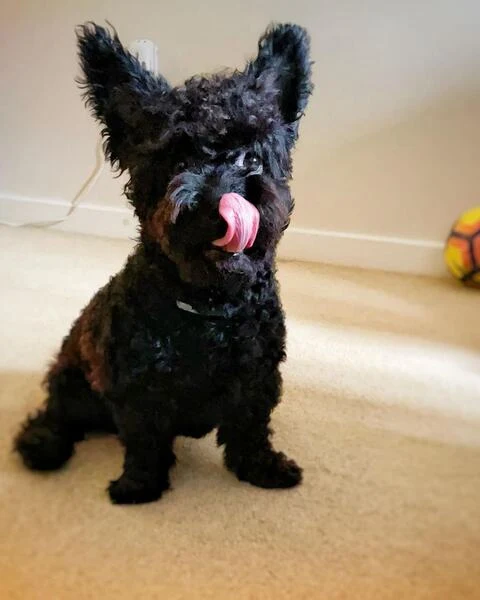
There is no single appearance that every Scoodle must have. A puppy may look more like its Scottish Terrier parent, more like its Poodle parent, or show a mixture of features from both.
Possible characteristics include:
- Build: A compact body, with proportions that vary between individual dogs.
- Coat texture: The coat may be relatively straight, wavy, curly, or wiry.
- Colour: Coat colour depends on the genes inherited from both parents.
- Ears: Their shape and carriage may vary; do not assume every Scoodle will have the same ear type.
- Expression: Many have an alert, curious expression, but head shape and facial furnishings differ.
The size of the Poodle parent is especially important. A cross involving a smaller Poodle may produce a smaller dog than one involving a larger Poodle. Even puppies from the same litter can develop differently, so prospective owners should ask for the parents' actual measurements and previous offspring sizes when available.
Scoodle Temperament: What Can You Expect?
The Scoodle combines two parent breeds with distinct histories and behavioural tendencies. Scottish Terriers were developed as working terriers, while Poodles have a long history as intelligent working and companion dogs. Their cross may inherit qualities from either parent, but the outcome cannot be predicted perfectly.
Traits a Scoodle may inherit from a Scottish Terrier
Scottish Terriers are often confident, determined, alert, and independent. These traits can make them entertaining companions, but they may also mean a dog is less inclined to repeat an exercise simply to please its owner.
Terrier instincts can influence how a Scoodle responds to small animals, unfamiliar dogs, and exciting outdoor distractions. Secure outdoor spaces, recall training, and supervised introductions are sensible precautions.
Traits a Scoodle may inherit from a Poodle
Poodles are known for their intelligence and ability to learn. A Scoodle may enjoy training games, food puzzles, and activities that require problem-solving. However, intelligence does not automatically make a dog easy to train: motivation, confidence, socialization, and consistency matter too.
Are Scoodles affectionate and good with children?
Some Scoodles are very affectionate with their families, while others may be more independent. Their suitability for a household with children depends on the individual dog's temperament and the way children interact with it.
Teach children not to pull a dog's ears or coat, disturb it while eating, or force contact when it wants space. Supervise interactions, particularly with young children. Introduce other pets gradually, since compatibility cannot be guaranteed by breed mix alone.
Exercise and Mental Stimulation
A Scoodle may be small, but that does not mean it will be happy with a short walk and no other activity. Both parent breeds can be alert and active, so plan for daily exercise and opportunities to use the dog's mind.
A practical routine may include:
- Daily walks adjusted to the dog's age, health, and energy level.
- Short games of fetch or tug, where appropriate for the individual dog.
- Reward-based training sessions to practise useful everyday skills.
- Sniffing walks and supervised exploration.
- Food puzzles and simple scent games to provide mental enrichment.
Puppies need a different exercise routine from healthy adults. Avoid forcing a young puppy into prolonged or strenuous activity, and ask your veterinarian for guidance on exercise as your dog grows.
Without enough stimulation, an individual dog may resort to barking, chewing, digging, or finding its own entertainment. These behaviours are not inevitable, and they should be addressed by looking at the dog's routine, training, and environment rather than simply assuming it is being stubborn.
How to Groom a Scoodle
Grooming needs depend on the coat the dog inherits. A curlier coat may trap loose hair and develop mats, while a wirier coat may need a different brushing and trimming approach. There is no single grooming schedule that works equally well for every Scoodle.
Brushing and trimming
Check the coat regularly and brush often enough to prevent tangles from tightening into mats. Pay particular attention behind the ears, beneath the legs, around the collar or harness, and anywhere the coat rubs against itself.
Some Scoodles may benefit from professional grooming every several weeks, but the appropriate interval depends on coat growth, length, condition, and the style you choose. Ask a groomer to demonstrate the right brush and comb for your dog's coat.
Bathing, nails, ears, and teeth
- Bathing: Bathe when needed using a dog-safe shampoo, and dry the coat thoroughly.
- Nails: Check regularly and trim when they become too long. Your veterinarian or groomer can show you how to avoid cutting the quick.
- Ears: Check for redness, odour, discharge, or discomfort. Use an appropriate ear cleaner only as advised by your veterinarian.
- Teeth: Brush regularly with dog-safe toothpaste. Small dogs can be particularly vulnerable to dental crowding and periodontal disease.
Introduce grooming gradually with treats and praise. Short, calm sessions can help a puppy become comfortable with brushing, nail handling, and being examined.
Are Scoodle Dogs Hypoallergenic?
No Scoodle can be guaranteed to be hypoallergenic. Poodles are often described as low-shedding dogs, but a Scoodle's coat depends on the genes it inherits from both parents. Some may shed relatively little; others may shed more or require more intensive coat maintenance.
Dog allergies are not caused by loose hair alone. Allergens can be present in skin flakes, saliva, and other sources, so a low-shedding coat does not guarantee that an allergic person will tolerate the dog.
If allergies are a concern, spend time with the specific dog before making a commitment, if possible. Even then, one visit cannot guarantee how you will react over time. Discuss significant allergies with a healthcare professional before bringing a dog home.
Training a Scottish Terrier Poodle Mix
A Scoodle may learn quickly but still have an independent streak. The best starting point is clear, consistent training built around rewards, rather than harsh corrections.
- Begin with everyday skills: Teach the dog's name, recall, loose-leash walking, settling, and polite greetings.
- Reward the behaviour you want: Use small treats, praise, or play when the dog responds appropriately.
- Keep sessions manageable: Several short sessions can be more effective than one long lesson.
- Socialize thoughtfully: Introduce different people, places, sounds, surfaces, and calm dogs gradually.
- Manage barking: Identify what triggers it, reward calm behaviour, and teach an alternative response.
- Practise alone time gradually: Build comfort with brief absences rather than suddenly leaving a dog alone for long periods.
Training should account for the individual dog. If your Scoodle becomes frightened, frustrated, or overly excited, reduce the difficulty and work at a pace it can manage. Seek help from a qualified reward-based trainer if behaviour problems persist.
For more on humane training approaches, see our guide to positive reinforcement versus traditional dog training.
Scoodle Health and Lifespan
Because the Scoodle is a cross rather than a standardized breed with one uniform health profile, it is not possible to give every Scoodle the same set of likely health problems. A mixed-breed dog can inherit health risks from either parent, and crossing two breeds does not eliminate inherited conditions.
Health concerns worth discussing with the breeder and veterinarian include:
- Eye conditions: Ask about eye examinations and inherited eye problems in both parent lines.
- Joint and mobility problems: Discuss appropriate screening based on the parents' size, health history, and veterinary recommendations.
- Skin and ear problems: Seek veterinary advice if itching, redness, odour, or repeated ear irritation occurs.
- Dental disease: Regular brushing and veterinary dental checks are important, particularly for smaller dogs.
- Inherited disorders: Ask which health tests are recommended for the specific Scottish Terrier and Poodle parents, rather than relying on a generic list.
How to help your Scoodle stay healthy
- Arrange regular veterinary examinations and follow the recommended vaccination and parasite-prevention plan.
- Feed a complete, balanced diet appropriate for the dog's age, size, and health.
- Keep the dog at a healthy body condition and provide suitable daily exercise.
- Brush the teeth regularly and address dental problems early.
- Ask the breeder for relevant health-test results and veterinary records for both parents.
A Scoodle's lifespan will depend on its inherited traits, overall health, and care. Be cautious of exact lifespan promises for this cross, and do not assume that a particular number of years is guaranteed.
Scoodle vs Other Poodle Mixes
If you are researching designer dogs, you may also come across other Poodle crosses. Their differences depend on the second parent breed, the size of the Poodle involved, and the traits inherited by the individual dog.
- Scoodle: A Scottish Terrier–Poodle cross that may combine terrier independence with Poodle intelligence.
- Whoodle: A Soft Coated Wheaten Terrier–Poodle cross, with size, coat, and temperament varying between dogs.
- Goldendoodle: A Golden Retriever–Poodle cross that is generally larger than a Scoodle involving a small Poodle.
These are not standardized breeds with guaranteed coat or personality outcomes. If you are comparing crosses, ask about the actual parent dogs, health testing, adult size, grooming needs, and behaviour of previous offspring where reliable information is available.
Related reading:
- Whoodle: Poodle and Soft Coated Wheaten Terrier Mix
- Goldendoodle: Things to Know Before Getting One
- 10 Fascinating Facts About the Poodle
Finding Scoodle Puppies or Adopting a Scoodle
Scoodles are not as consistently available as many established breeds, so finding a suitable puppy may take time. The most important step is to assess the breeder's practices and the health and temperament of the parent dogs—not simply to find the lowest price or the earliest available litter.
Questions to ask a breeder
- Can I meet the puppy with its mother and see where the puppies are raised?
- What are the adult sizes, temperaments, and health histories of both parents?
- Which health tests are appropriate for the Scottish Terrier and Poodle parents, and can I see the results?
- What veterinary examinations, vaccinations, parasite treatments, and records will the puppy receive?
- How are the puppies being introduced to handling, household sounds, and everyday experiences?
- What support is available if the puppy develops a health or behaviour problem?
A responsible breeder should answer reasonable questions, provide clear records, and allow you time to make a decision. Be wary of sellers who refuse to provide verifiable information, pressure you to pay immediately, or offer to send a puppy without appropriate checks.
How much does a Scoodle puppy cost?
There is no reliable universal price for a Scoodle puppy. Cost varies with location, breeder practices, parent dogs, veterinary care, and local demand. Rather than relying on a fixed online price range, request a written breakdown of the price and what it includes.
Remember to budget for ongoing expenses such as food, routine veterinary care, preventive medication, grooming, training, equipment, and unexpected medical costs. Adoption may also be an option: contact local shelters and rescue organizations and ask about small mixed-breed dogs or Poodle and Scottish Terrier crosses.
Is a Scoodle Right for You?
A Scoodle may suit you if you want a small companion, enjoy teaching a dog new skills, and can commit to regular grooming and daily interaction. Its terrier ancestry may also appeal to owners who appreciate a confident, curious dog with an independent side.
Think carefully before choosing a Scoodle if you need a dog with a guaranteed adult size, a predictable coat, minimal grooming needs, or a reliably allergy-friendly coat. Those qualities cannot be promised in this cross.
Families with young children should choose an individual dog carefully and supervise interactions. People who spend long periods away from home should also plan how to meet the dog's social and exercise needs.
Frequently Asked Questions About Scoodle Dogs
What is a Scoodle dog?
A Scoodle is a cross between a Scottish Terrier and a Poodle. It is also called a Scottie Poodle Mix or Scottish Terrier Poodle Cross. Appearance, size, coat, and temperament vary according to the traits inherited from the parents.
How big does a Scoodle get?
There is no single standard adult size for Scoodles. Their size depends partly on the size of the Poodle parent and the traits inherited from both parents. Ask the breeder about the parents' actual height and weight, while remembering that these figures cannot predict a puppy's adult size exactly.
Is a Scoodle a recognized dog breed?
The Scoodle is a designer cross between a Scottish Terrier and a Poodle, rather than a standardized breed with one universally accepted appearance and breed standard.
Are Scoodles good family dogs?
Some Scoodles can be affectionate family companions, but suitability depends on the individual dog's temperament, socialization, and training. Supervise children around dogs and teach them to handle a small dog gently and respectfully.
Do Scoodles shed?
Shedding varies. Some Scoodles may inherit a relatively low-shedding coat, while others may shed more. The coat should be assessed individually rather than assuming every Poodle cross sheds very little.
Are Scoodles hypoallergenic?
No Scoodle is guaranteed to be hypoallergenic. People with dog allergies can react to allergens from skin flakes, saliva, and other sources, even when a dog sheds very little. If you have allergies, spend time with the individual dog before making a commitment and consult a healthcare professional if needed.
Are Scoodles easy to train?
A Scoodle may inherit the Poodle's learning ability and the Scottish Terrier's independent nature. Reward-based training, consistent rules, early socialization, and short practice sessions can help, but individual dogs vary in how quickly they learn.
How much exercise does a Scoodle need?
Most Scoodles will need daily walks, play, and mental stimulation, but the right amount depends on age, health, and energy level. Start with an appropriate routine and adjust it to your dog's needs rather than following a rigid exercise target.
How much does a Scoodle puppy cost?
Prices vary by location, breeder, parent dogs, and the care provided. There is no universally reliable price range for Scoodles. Ask what the price includes and check the breeder's health testing, veterinary records, and puppy-rearing practices before paying a deposit.
What is the lifespan of a Scoodle?
A precise lifespan cannot be guaranteed for this cross. Genetics, health, nutrition, preventive veterinary care, and lifestyle all affect longevity. Ask about the health and ages of related dogs where reliable information is available.
Final Thoughts
The Scoodle brings together two distinctive breeds: the Scottish Terrier and the Poodle. The result can be a clever, lively, affectionate companion, but it may also inherit an independent streak and a coat that needs regular attention.
Before choosing a puppy, learn about both parents, ask for appropriate health-test results, and be realistic about grooming, exercise, training, and the time you can spend with your dog. A well-matched Scoodle can be a rewarding companion, but the best choice is an individual dog whose needs fit your household—not a promise based on its mix alone.
